+420 770 134 567
  info@esthesion.cz
  Jugoslávských partyzánů 15, Prague 6
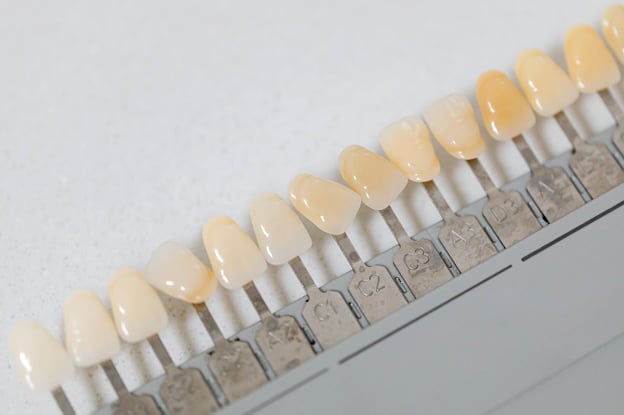
Do you dream of a beautifully white smile? Teeth whitening is one of the most sought-after aesthetic procedures in dental care — whether you choose at-home whitening or in-office whitening, the result may pleasantly surprise you.
At Esthesion, we offer both whitening options, each with its own advantages. We will be happy to help you choose the most suitable one for you.
Why do teeth darken?
Tooth discolouration can be caused by a wide range of factors — from consuming coffee, tea, red wine, or smoking, to ageing, genetics, or the use of certain medications. Teeth whitening helps remove pigmentation and restores your teeth to their naturally fresh appearance.
How does whitening work?
The active whitening agent is hydrogen peroxide, carbamide peroxide, or sodium perborate. For each patient, there is an individual threshold beyond which these substances can damage the teeth.
If the dentist reaches this threshold, the whitening process is stopped immediately, even if the desired result has not yet been achieved. The whitening process is also stopped in cases of allergic reaction, tooth pain, or enamel erosion.
When whitening non-vital (root-canal treated) teeth, the whitening material is not applied to the enamel but from inside the tooth, which may lead to damage to the root system, or fracture or cracking of the dental crown. When the gel is applied to the tooth, the carbamide peroxide breaks down and releases oxygen, which penetrates the dentin and enamel and bleaches pigment deposits. The tooth structure remains unchanged.
Clinical tests have demonstrated that the whitening system is completely safe.
In-office teeth whitening
How does it work?
In-office whitening is performed directly at our clinic under the supervision of an experienced dentist or dental hygienist. First, the teeth are thoroughly cleaned and their condition is checked. The gums are protected with a special gel or rubber dam. Then, a whitening gel (usually hydrogen peroxide-based) is applied and activated using a special LED or UV lamp. The whitening process takes place in 2–3 cycles of approximately 15–20 minutes, so the entire procedure lasts about 60–90 minutes.
Technologies used
At Esthesion, we work with the modern and gentle Opalescence whitening systems, which combine high effectiveness with maximum safety.
Results
The result is visible immediately after the procedure — teeth can be 4–5 shades lighter. The effect lasts 1–3 years depending on lifestyle.
At-home teeth whitening
How does it work?
At-home whitening uses custom-made trays (splints) that you fill with a special whitening gel and wear according to your dentist’s recommendations, usually for 1–2 weeks, approximately 1–2 hours per day or overnight.
Advantages and usage
This method is gentler and allows for gradual lightening of teeth in the comfort of your home. It is also ideal as a maintenance method after in-office whitening.
- It is gentle and gradual
- You have the whitening fully under your control
- Ideal as a maintenance method after in-office whitening
Products used
We most commonly use professional whitening gels with carbamide peroxide from trusted brands such as Opalescence.
Price
The price of at-home whitening and in-office whitening is according to our current price list.
Is whitening safe?
Yes — if performed professionally. At Esthesion, everything takes place under the supervision of experienced staff. Short-term tooth sensitivity is common but subsides quickly. Whitening does not damage tooth enamel and does not affect fillings or crowns.
Will whitening hurt?
Whitening itself is not painful, but it may cause temporary tooth or gum sensitivity — this usually subsides within a few hours to days. We will recommend sensitivity-reducing gels or toothpastes.
How long does the whitening result last?
The result of in-office whitening usually lasts 1–3 years, depending on how you care for your teeth and your lifestyle. For at-home whitening, it depends on the length and regularity of the treatment.
Can I whiten my teeth if I have fillings, crowns, or veneers?
Whitening only works on natural teeth — fillings, crowns, and veneers do not change their shade. If they are in the visible part of your smile, they may need to be replaced after whitening.
How often can I repeat whitening?
We recommend in-office whitening no more than once a year. At-home whitening (e.g. as a maintenance treatment) can be done more frequently as recommended by your dentist.
What should I not eat or drink after whitening?
After whitening, we recommend avoiding foods and drinks with intense colour (coffee, red wine, blueberries, curry, etc.) and smoking for 24–48 hours. In short: follow the so-called white diet.
Who should not have whitening?
Whitening is not recommended for children, pregnant or nursing women, and people with untreated dental problems. It is also good to know that crowns, veneers, and fillings will not change their shade.